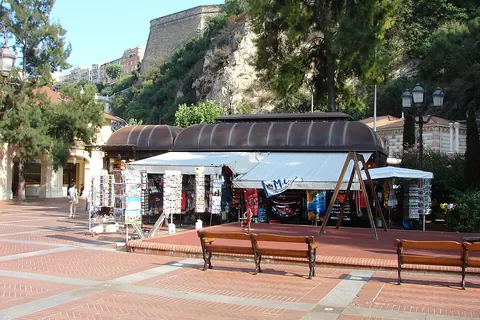

At the foot of the Rock, the Place d’Armes takes its name from the soldiers who once drilled here in the shelter of the ramparts. It is where the old town meets the Condamine district, and the historic start of the Rampe Major. Every year in late January, the square hosts a festival dear to Monegasques: Saint Devota, patron saint of the principality. On the eve of her feast, a boat is set alight here in memory of the saint’s legend, watched by the princely family, in an atmosphere both solemn and festive. The rest of the year, the square lives to the rhythm of the nearby market, café terraces and the buses climbing up to the Palace. Look around: the colourful facades, ochre, pink and yellow, give this corner of Monaco the air of a Ligurian village. It is an excellent starting point for exploring the Rock on foot.
History
Look up: the Rock rises above you. On 10 June 1215, Genoese forces began building a fortress there, and in 1297 François Grimaldi seized it. For centuries, life was concentrated up there, behind the ramparts, while down below, at the foot of the cliff, there were mostly gardens.
According to the account handed down to us, François Grimaldi, disguised as a Franciscan friar, had the fortress gates opened before letting his men in. This ruse earned him the nickname Malizia, which is why two monks armed with swords still appear on Monaco’s coat of arms. The way up to those gates starts right here.
The Place d’Armes, which many Monegasques simply call the Market Square, changed role in the 19th century. A market settled here in 1880, and the square became a crossroads: this is where the path up to the Rock, the road to La Turbie and the road to Nice meet.
Art and architecture
In the 20th century, the Condamine was gradually built up, and the square became a place of passage. First came a tram stop, then a bus stop, and parking along the arcades. The 1911 constitution even made the Condamine one of the principality’s 3 municipalities, before a return to a single municipality in 1917.
Today the square keeps this dual identity: an open space for traffic, and a neighbourhood heart lined with colourful facades, café terraces and the market next door.
Anecdotes
Its name recalls the soldiers who once drilled here, sheltered by the ramparts. But everyday life won out: locals go to "the square" to shop, have a coffee or wait for the bus up to the Palace.
The square is also a gathering place. Every year at the end of January, the festivities of Saint Devota, patron saint of the principality, bring the whole district to life, between the square and the nearby church at the bottom of the valley.
What to look for
Stand in the middle and turn around slowly: on one side, the ramparts and the start of the Rampe Major; on the other, the arcades and buildings of the Condamine; further on, the opening towards Port Hercules. Notice the ochre, pink and yellow facades that give the square its Ligurian feel. In the morning, the market stalls add their colours.
Practical
The square is open at all times. Several bus lines stop here, including those going up to the Rock. The market usually runs in the morning. For bus times and the festival programme, check the official websites of the Compagnie des Autobus de Monaco and the town hall.
Nearby
Right next door, step into the Condamine Market, then walk up to the Palace via the Rampe Major. Heading down to the sea, you will reach Port Hercules in a few minutes, and the Church of Saint Devota a little further on.
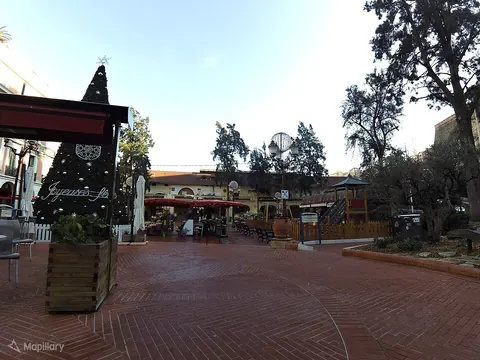

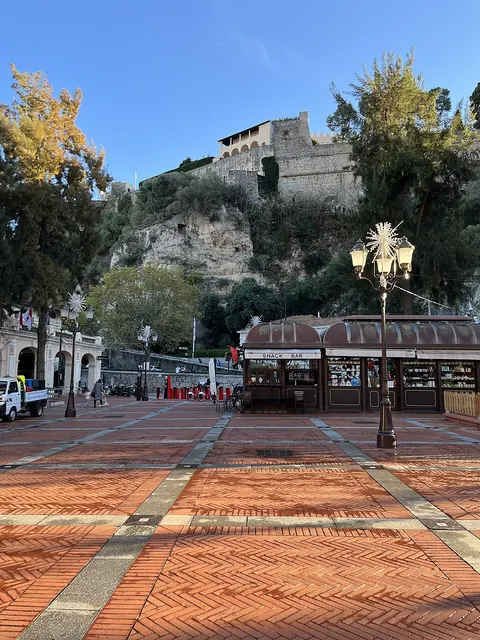

On site, look for: Find three facades of different colours around the square.
Test yourself
Where does the name come from?
- A coat of arms
- An arms dealer
- Soldiers who drilled here (answer)
Which festival is held here in late January?
- Carnival
- Saint Devota (answer)
- The Grand Prix
What is burned that night?
- A boat (answer)
- A car
- A flag
Sources
- Wikipédia : Place d’Armes (Monaco)
- Wikipedia: Monaco-Ville
- Mairie de Monaco : le Marché de la Condamine
Information checked on 30 September 2026.