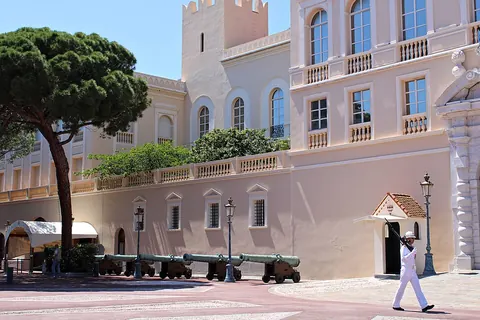

Here stands the Prince’s Palace, the beating heart of the Rock. The story begins in 1191, when Genoa acquired this headland and built a fortress to watch over the coast. On the night of 8 January 1297, so the tradition goes, François Grimaldi, nicknamed Malizia, the cunning one, knocked at the gate disguised as a Franciscan monk. The door opened, his men rushed in, and the fortress changed hands. That is why two sword wielding monks still hold the coat of arms of Monaco today. Over the centuries the citadel became a palace: Renaissance princes added frescoed galleries, a grand courtyard and a horseshoe staircase inspired by Fontainebleau. Look up at the tower: when the princely flag is flying, the sovereign is in residence. Every day at five to twelve, the Prince’s Carabiniers, in white uniforms in summer and black in winter, perform the changing of the guard. Arrive early, the square fills quickly, and admire the old cannons lined up facing the sea.
History
Before it was a palace, this was a fortress. In 1191 the Republic of Genoa acquired the Rock, on condition that it protect the coast from pirates. Work began in 1215: a defensive wall flanked by 4 towers, whose outline still forms the heart of today’s building. In 1297 François Grimaldi seized it by trickery, and ever since it has remained his family’s home, something rare among Europe’s dynasties.
For centuries, defence came first. In December 1506, 14,000 Genoese soldiers besieged the Rock. Around 1,500 defenders held out for 5 months and won in March 1507. Little by little, thanks to alliances, the fortified house became a palace. Then came the Revolution: in 1793 Monaco was annexed by France, the prince was imprisoned, the palace looted and its furniture auctioned off. It took the whole 19th century, and then the long reign of Rainier III from 1949, to restore its splendour.
Art and architecture
In the 16th century, under Honoré I, the inner courtyard was rebuilt. The architect Dominique Gallo designed arcades of 12 arches with white marble balustrades. The upper gallery is now called the Gallery of Hercules, because its ceilings, painted by Orazio de Ferrari, tell the story of the hero’s labours. Opposite, the Genoese painter Luca Cambiaso covered the walls with frescoes.
In the 17th century, Prince Louis I looked to Fontainebleau for inspiration. He gave the court of honour its double horseshoe staircase, whose 30 steps are said to have been carved from a single block of Carrara marble. It opens the ceremonial route through the State Apartments: the Mirror Gallery, the Blue Room with its Murano chandeliers, then the Throne Room, the largest, where state ceremonies have been held since the 16th century.
Anecdotes
The very name of Monaco comes from Hercules: the Romans worshipped Hercules Monoikos here and called the harbour Portus Herculis Monoeci. That is why the hero appears on the gallery ceilings.
In 1529 Emperor Charles V spent 4 nights at the palace, on his way to Bologna to be crowned by the Pope. Later, Cardinal Mazarin, related to the Grimaldis by marriage, left his mark: a drawing room bears his name, lined with painted and gilded panelling by Italian craftsmen he had brought to France, and his portrait hangs above the fireplace.
In April 1956, the wedding of Rainier III and the American actress Grace Kelly placed the palace in the imagination of the whole world.
What to look for
On the square, look for the statue of François Grimaldi disguised as a monk, his sword hidden under his robe: it recalls the night of 1297. Then look up at the tower: the princely flag shows that the sovereign is in residence.
Every day at around 11:55 a.m., the Prince’s Carabiniers change the guard in front of the entrance. Arrive 20 minutes early to stand in the front row. Since 1960 the court of honour has also hosted open-air concerts by the Monte-Carlo Philharmonic Orchestra, a rare chance to see the marble staircase up close.
Practical
You can walk up to the Palace Square from the harbour by the Rampe Major, a cobbled climb of about 10 minutes, or use the public lifts that serve the Rock.
The State Apartments are usually open only during the warmer months, as the palace remains the prince’s home and workplace. Opening dates, times and prices change every year: check the official website palais.mc before you come.
Nearby
A few minutes’ walk away you will find the cathedral, where Grace and Rainier III are buried, then the Saint-Martin Gardens and the Oceanographic Museum. To go further, palais.mc presents the history of the princes and the rooms open to the public.
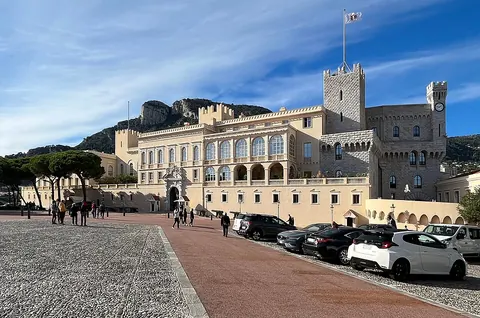

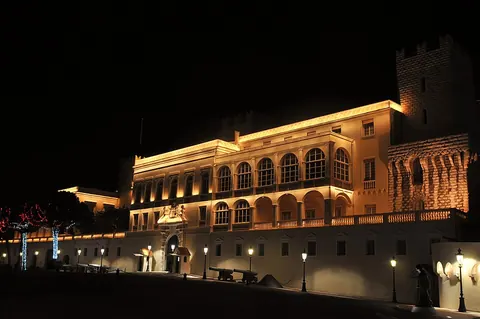

On site, look for: Find the Grimaldi coat of arms above the main gate and count the monks holding it.
Test yourself
In which year did the Grimaldis seize the fortress?
- 1191
- 1297 (answer)
- 1863
What disguise did François Grimaldi wear?
- A merchant
- A monk (answer)
- A soldier
When is the changing of the guard?
- Around 11:55 am (answer)
- At 6 pm
- At 9 am
Sources
- Wikipédia : Palais princier de Monaco
- Wikipedia: Prince’s Palace of Monaco
- Visites du Palais princier de Monaco
Information checked on 30 September 2026.