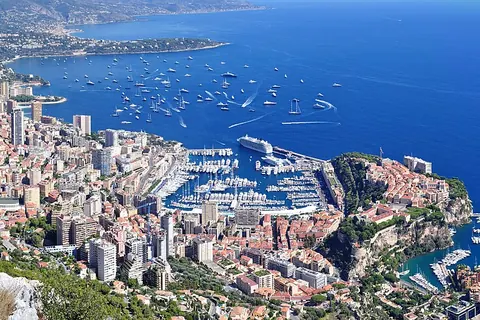

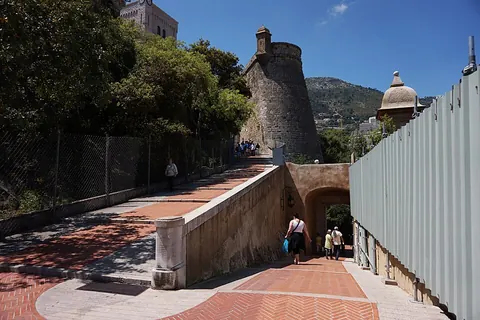
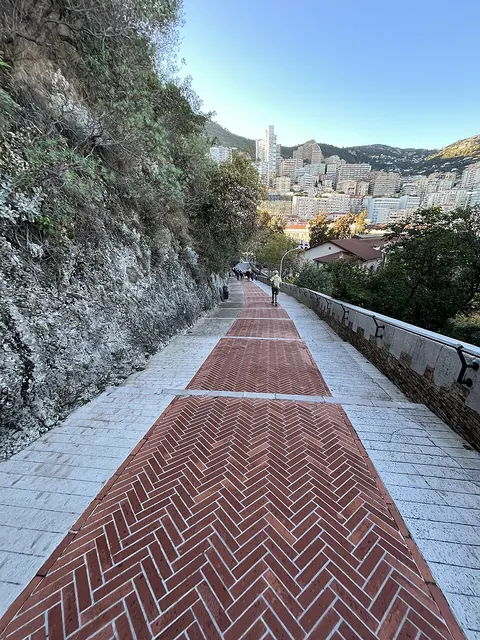
This long cobbled climb, lined with battlemented walls, is called the Rampe Major. For centuries it was the main way into the fortress for anyone coming up from La Condamine. You pass through several gates, some dating from the sixteenth and seventeenth centuries: each one was an extra lock against attackers. It is easy to imagine soldiers, laden mules and merchants toiling up this slope. Today it is the walkers’ favourite route and perhaps the loveliest way to reach the Palace. Stop at the lookout: below you, Port Hercule draws its almost perfect basin full of yachts, and opposite, the buildings of Monte Carlo rise in tiers towards Mont Agel. In the evening, when the lights come on, the view is magical. The Rock itself rises some sixty metres above the sea, which is what made it such a coveted stronghold. Catch your breath: the climb is worth it.
History
To understand this climb, go back to 10 June 1215. That day, Genoese forces led by Fulco del Cassello began building a fortress on the Rock, to turn it into a military stronghold able to control the coast. They also built dwellings and exempted newcomers from taxes.
On 8 January 1297, François Grimaldi seized the stronghold disguised as a Franciscan friar. From then on the Rock remained the Grimaldi citadel, and the approach from the Condamine, the one you are taking, was one of its main routes. The successive gates of the Rampe Major, some dating from the 16th and 17th centuries, recall this defensive past.
Art and architecture
The ramp is a paved climb in broad steps, lined with crenellated walls. Its gentle gradient suited both people and pack animals. Each gate formed a barrier: an attacker had to force them one after another, under fire from above.
At the top, the viewpoint opens onto a landscape shaped in the 20th century. Port Hercules, completed in 1926 and later enlarged, spreads its basin of about 16 hectares. Offshore, the 352 metre semi floating breakwater, brought from Spain in 2002, shelters the outer harbour.
Anecdotes
The ruse of 1297 explains the two monks armed with swords on Monaco’s coat of arms. François Grimaldi earned his nickname from it: Malizia, meaning cunning. As you climb, picture his small band waiting for the gate to open.
Another curiosity: the Rock has not always had the same status. The 1911 constitution made Monaco-Ville one of the principality’s 3 municipalities, before a return to a single municipality in 1917.
What to look for
Stop at each gate to see how thick the walls are. At the viewpoint, pick out from left to right the Condamine, Port Hercules with its 700 or so berths, then Monte Carlo. In the evening, the lights of the port and the buildings offer a very different view from daytime.
Practical
The ramp starts from the Place d’Armes and reaches the Palace in about ten minutes at an easy pace. It is open day and night. The slope and paved steps make it difficult with a pushchair or wheelchair: in that case, take the bus up to the Rock. Bring water in summer.
Nearby
At the top, the Palace square awaits, with the changing of the guard. Below, the Condamine Market and Port Hercules are just steps away. For Palace opening times, see the official website palais.mc.


On site, look for: Count the gates you pass through up to the Palace.
Test yourself
How high is the Rock?
- About sixty metres (answer)
- Ten metres
- Three hundred metres
Where did the ramp start?
- Fontvieille
- La Condamine (answer)
- Monte Carlo
Which harbour can you see?
- Genoa harbour
- Nice harbour
- Port Hercule (answer)
Sources
- Wikipédia : Rocher de Monaco
- Wikipedia: Monaco-Ville
- Wikipédia : Port Hercule
- Musée océanographique : infos pratiques
Information checked on 30 September 2026.