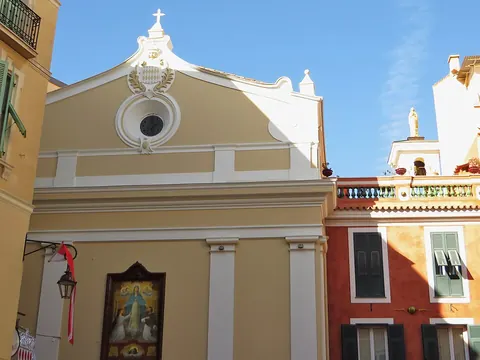
Tucked away on the Town Hall square, the Chapel of Mercy dates from 1639. It was built for the Brotherhood of the Black Penitents, lay people devoted to charity: they visited the sick, comforted the condemned and buried the poor. Its striped facade of pale stone and pink brick is typical of Ligurian Baroque, a reminder of the close ties between Monaco and Genoa. Inside, look for a carved wooden figure of the dead Christ, attributed to the Monegasque sculptor François-Joseph Bosio, who worked for Napoleon. Every year on the evening of Good Friday, the statue is carried in procession through the torch lit lanes of the Rock, in striking silence. It is one of the oldest and most moving traditions in the principality, and the sovereign prince has long been counted among the brotherhood’s members. Step inside if the door is open: after the bustle of the streets, the calm is remarkable.
History
The chapel’s first stone was blessed in 1639, during the reign of Honoré II. The prince was more than a patron: he was himself prior of the Confraternity of the Black Penitents, which built the chapel. These lay people devoted themselves to works of charity, and their chapel became the heart of their religious life on the Rock.
In October 1813 the Black Penitents were joined by the Confraternity of the White Penitents. Together they formed a single confraternity, that of Mercy, which gives the chapel its name. It still exists today as the Venerable Archconfraternity of Mercy. After major restoration work, the chapel was blessed again on 30 October 2012 by Cardinal Dominik Duka, Archbishop of Prague, in the presence of Prince Albert II.
Art and architecture
Built at the height of the Baroque, the chapel brings together sculptures, paintings, gilding and marble in a modest space. On the façade, look up at the ceramic showing the Virgin surrounded by Black Penitents, with the head of Saint John the Baptist in the lower part. It was made in 1909 by Ernesto Sprega, a master of Monegasque terracotta.
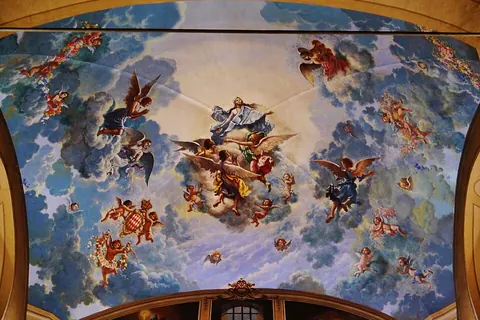
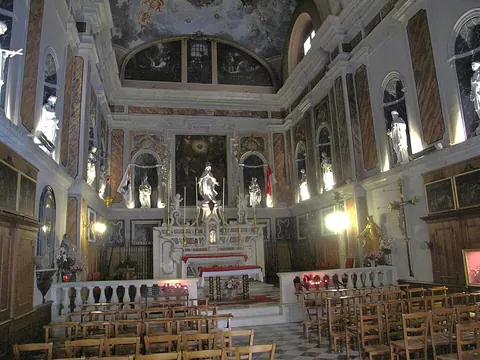
Inside, the altar is of polychrome marble. Above it, frescoes from 1953 depict the Assumption of the Virgin. On the walls, a collection of paintings includes The Deliverance of Souls from Purgatory, in which local saints appear.
Anecdotes
The most famous piece is the Christ carved from solid wood, attributed to the Monegasque François-Joseph Bosio, who became official sculptor to Emperor Napoleon I. It is this figure that is carried on the evening of Good Friday, in the procession of the Dead Christ.
The procession has set out from the chapel for four centuries. It did, however, have a long break: abolished in 1870, it was revived only more recently, and is once again one of the great moments of Holy Week in Monaco.
The chapel also keeps, in a reliquary, a relic of Saint Devota, patron saint of the principality.
What to look for
Before going in, take time to look at the façade and its 1909 ceramic. Once inside, find the recumbent Christ, then look up at the Assumption frescoes above the altar.
Stop in front of the painting of the Deliverance of Souls from Purgatory and try to recognise the local saints. Finally, look for the reliquary of Saint Devota.
Practical
The chapel stands on the Place de la Mairie, in the heart of the lanes of Monaco-Ville, a few minutes’ walk from the Palace Square and the cathedral.
It is a place of worship: Sunday Mass is celebrated here in the Tridentine rite. Modest dress and discretion are expected, and visits are not possible during services. Opening times vary: check visitmonaco.com or the website of the Archdiocese of Monaco.
Nearby
On the Rock, the house of the sculptor François-Joseph Bosio recalls the local boy who became an artist of the Empire. Then continue to the cathedral, which also holds works linked to the confraternities, such as the altarpiece of the White Penitents. The National Committee for Monegasque Traditions also presents the history of the Archconfraternity.


On site, look for: Count the pink brick stripes on the facade.
Test yourself
For which brotherhood was it built?
- The Black Penitents (answer)
- The Carabiniers
- The Templars
When is the statue carried in procession?
- At Christmas
- On 14 July
- On Good Friday (answer)
When does the chapel date from?
- 1297
- 1639 (answer)
- 1910
Sources
Information checked on 30 September 2026.