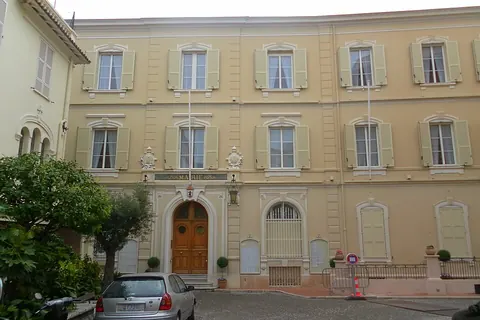

You are on Place de la Mairie, in the heart of Monaco-Ville. The building in front of you houses the town hall of the Principality’s only municipality: the offices of the mayor and the Communal Council are here. Yet these walls were first a school. In 1881 the Collège Saint-Charles was founded here, run at first by priests of various origins and later by the Marianist Brothers. Among its pupils, from 1888 to 1896, was a boy destined for fame: Guillaume Apollinaire, the future poet of "Alcools". Picture him crossing this square with his exercise books, long before he became one of the great voices of French poetry. On 20 May 1901, at 3 pm, the premises were inaugurated in their new role as the town hall, which they have kept ever since. Today the square is a peaceful crossing point between the Palace and the cathedral. Take a moment to look at the façade, then let your steps lead you into the nearby lanes, which have kept their old layout.
History
Place de la Mairie lies at the centre of Monaco-Ville, the district on the Rock. The building along it houses Monaco Town Hall, seat of the mayor and the Communal Council. A Monegasque particularity: the Principality has only one municipality, whose territory is the same as the State’s. The town hall therefore runs municipal affairs for the whole country, alongside the Prince’s government a few steps away.
Before becoming a town hall, the building was a school. The Collège Saint-Charles was decided upon and founded in 1881. The Prince first entrusted it to independent priests of various origins, then placed it under the direction of the Marianist Brothers.
At the turn of the century the premises changed purpose. On 20 May 1901, at 3 pm, the new layout was inaugurated: the former school became Monaco Town Hall. More than 120 years later, it still fulfils that role.
Art and architecture
The building dates from the 19th century. Its sober façade, aligned on the square, matches the architecture of Monaco-Ville, where public buildings stand beside houses with coloured façades. There is no spectacular monument here: the square is valued above all for its small capital atmosphere, with its paving stones, benches and lanes leading off it.
The square belongs to a coherent whole: the Chapel of Mercy (Miséricorde) is close by, and both the Prince’s Palace and the cathedral are only a few minutes’ walk away. This proximity tells the story of how the Rock is organised, with princely power, religious life and municipal administration sharing a very small space.
Anecdotes
The most famous pupil of the Collège Saint-Charles is Guillaume Apollinaire. He studied here from 1888 to 1896, before becoming one of the major poets of the early 20th century, author of "Alcools" and "Calligrammes". The young boy thus spent part of his childhood on this Rock, within walls that became the town hall a few years after he left.
The 1901 inauguration is known to the hour: 3 pm on 20 May. This detail, preserved in the records, shows how important the event was for a municipality that finally received premises suited to its functions.
What to look for
Look at the façade and the municipal emblem, then walk around the square to see how it opens onto the lanes of Monaco-Ville. Spot the nearby Chapel of Mercy. Looking up, you will see the warm coloured façades typical of the Rock, with their shutters and balconies. Take time, too, to sit on a bench for a moment: away from the main routes, the square is one of the quietest corners of the Rock.
Practical
The square is freely accessible at any time. The building is an administrative office, not a museum: service opening hours are on the official website mairie.mc. From the Palace Square, allow about 5 minutes on foot through the lanes. The Rock is best explored entirely on foot, with paving stones that can be slippery: wear good shoes.
Nearby
Continue to the Chapel of Mercy, the Palace Square or the Cathedral of Our Lady Immaculate. To learn about the municipality and its events, visit the official website of the Mairie de Monaco. Readers of Apollinaire may enjoy rereading "Alcools" with these Monaco years in mind.
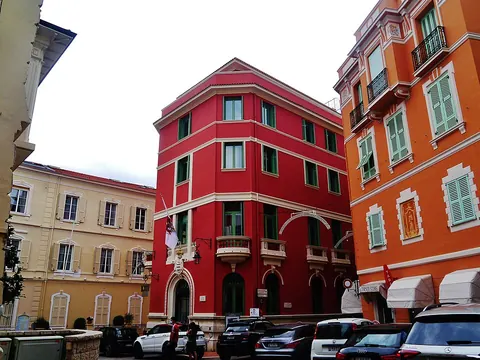

On site, look for: Find the inscription or emblem on the façade that shows the building’s role, then look for a detail on the square in Monaco’s red and white colours.
Test yourself
What occupied this building before the town hall?
- A Capuchin convent
- A Carabiniers barracks
- The Collège Saint-Charles (answer)
Which poet studied here?
- Arthur Rimbaud
- Guillaume Apollinaire (answer)
- Paul Valéry
In which year was the town hall inaugurated here?
- 1881
- 1901 (answer)
- 1911
Sources
Information checked on 30 September 2026.