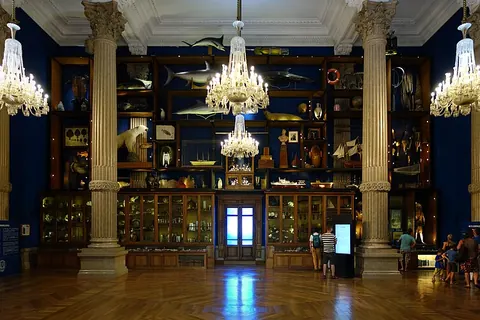

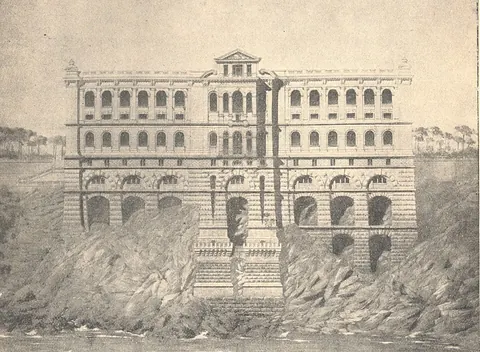
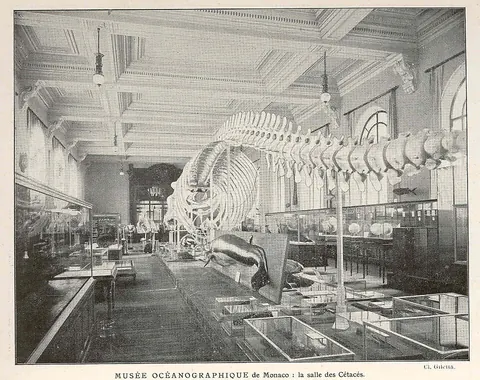
Clinging to the cliff, eighty five metres above the waves, this stone palace is devoted to the sea. It was the dream of Prince Albert I, known as the scientist prince. Passionate about oceanography, he led dozens of expeditions aboard his yachts, hauling unknown creatures up from the deep. The museum opened in 1910 after more than ten years of work, and its facade bears the names of the ships that served science. From 1957 to 1988 it was directed by Commander Jacques-Yves Cousteau, who made it world famous. Today the aquarium displays thousands of animals, from tropical lagoons to Mediterranean waters, with a spectacular shark tank. Upstairs you will find whale skeletons, antique instruments and cabinets of curiosities. Do not miss the rooftop terrace: the view takes in the Rock, the harbour and, on a clear day, the Italian coast. Children love the touch pool, where they can gently stroke some of the animals.
History
Prince Albert I devoted much of his life to the sea. As early as 1885 he considered creating a marine biology laboratory in Monaco. The idea grew after the success of his scientific collections at the Paris World’s Fair in 1889: he wanted a place to display them and bring the sea to the public. The first stone was laid on 25 April 1899, and the museum was inaugurated on 29 March 1910.
For the opening, Albert I invited the leading oceanographers of his day. Those meetings gave rise to the idea of a scientific commission devoted to the Mediterranean, which still exists. From 1957 to 1988 the museum was directed by Commander Jacques-Yves Cousteau. It celebrated its centenary in 2010, after major renovation.
Art and architecture
The plans were drawn by the French architect Paul Delefortrie. Construction took 11 years, because the building had to rise from sea level up the cliff to a height of 85 metres, while respecting the neighbouring Saint-Martin Gardens. The 100-metre-long building is made of white stone from La Turbie, with limestone from Brescia for the columns and the grand staircase.
On the main façade, two sculpted groups by Gustave Dussart were unveiled in 1903. At the top, the frieze bears the names of some 20 oceanographic research vessels, chosen by Albert I himself.
Anecdotes
The prince’s expeditions served medicine. Observations made aboard his ships led to the understanding of anaphylaxis, which earned Dr Charles Richet the Nobel Prize in Medicine in 1913. On the first floor, the room devoted to Albert I’s career as a sailor displays the laboratory from L’Hirondelle, his first research yacht.
The museum also welcomes contemporary art. For the centenary Damien Hirst showed Cornucopia here, and later the Chinese artist Huang Yong Ping hung a huge 25-metre creature, half octopus and half cuttlefish, in the main hall.
A less glorious episode: in 1989 a biologist spotted a tropical seaweed, Caulerpa taxifolia, at the foot of the museum. The exact origin of this introduction is still debated.
What to look for
Downstairs, the aquarium presents the ecosystems of the Mediterranean and tropical seas, including the shark lagoon with its living coral reef. The aquarium takes part in conservation programmes: a coral farm and breeding of clownfish, seahorses and cuttlefish.
Upstairs, take time to see the skeletons of large marine animals, the model ships and the scientific instruments. Finish on the roof terrace: the view takes in the Rock, the harbour and the whole coast.
Practical
The museum stands on Avenue Saint-Martin at the cliff edge, about 10 minutes’ walk from the Palace Square through the lanes or the Saint-Martin Gardens.
Allow at least 2 hours. The museum is usually open every day, but times and prices vary with the season: check them on the official website oceano.org, where you can also book tickets.
Nearby
The museum belongs to the Oceanographic Institute, a foundation created by Albert I that continues his work of sharing knowledge about the oceans. To round off your visit, the Saint-Martin Gardens next door hold a statue of the navigator prince, and the nearby cathedral contains his tomb.
If you enjoy cabinets of curiosities, note that in 2011 the American artist Mark Dion designed for the museum, in the Oceanomania exhibition, a giant cabinet 18 metres wide and 10 metres high, filled with pieces from the collections: models, jars and instruments. The museum now welcomes more than 600,000 visitors a year, so come early in the morning to enjoy the rooms in peace.


On site, look for: On the facade, find the name of one of Prince Albert I’s ships.
Test yourself
Who founded the museum?
- Albert I (answer)
- Charles III
- Rainier III
Which famous commander ran it?
- Jacques-Yves Cousteau (answer)
- Jules Verne
- Éric Tabarly
When did it open?
- 1863
- 1910 (answer)
- 1985
Sources
- Wikipédia : Musée océanographique de Monaco
- Wikipedia: Oceanographic Museum of Monaco
- Musée océanographique : infos pratiques
Information checked on 30 September 2026.