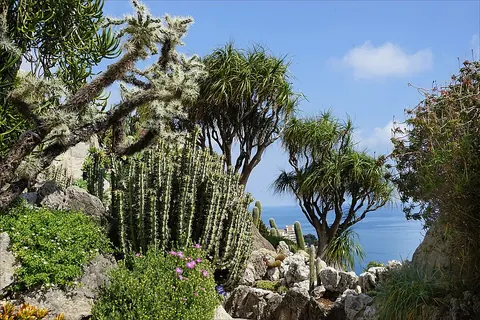
Clinging to the cliff in the Moneghetti district, the Exotic Garden is one of the botanical treasures of the Riviera. The idea came from Prince Albert I, and the land was bought in 1912; work began in 1913 under the Monegasque engineer Louis Notari. Open to the public from 1931, the garden was officially inaugurated on 7 February 1933 by Prince Louis II. It enjoys an exceptional microclimate: the rock stores the sun’s heat and releases it at night, so desert plants thrive in open ground. Giant cacti, euphorbias, aloes and agaves from Mexico, South Africa or Arabia create an astonishing, almost lunar landscape. Some specimens are more than a hundred years old. Below the garden lies the Observatory Cave, where you descend among stalactites and stalagmites; traces of prehistoric occupation were found there. The cave can only be visited with a guide. From the top, the view over the principality, Fontvieille and the sea is breathtaking. After nearly six years of works, the garden was inaugurated on Wednesday 25 March 2026 in the presence of Prince Albert II and Princess Charlene, the Princess of Hanover, the Mayor of Monaco Georges Marsan and members of the Communal Council, with a blessing by Archbishop Dominique-Marie David of Monaco. It reopened to the public on Monday 30 March 2026, with rebuilt walkways and railings, a children’s playground, a picnic area and a bar. Check opening times before you climb up. Wear good shoes: the paths are steep, with many steps.
History
Succulent plants reached Europe from Mexico in the late 1860s, after the French intervention in that country. In Monaco they found an ideal climate.
The story begins with a gardener’s passion. From 1895 Augustin Gastaud, chief gardener of the State Gardens, grew succulents in the Saint Martin Gardens on the Rock. Prince Albert I, who passed by on his way to the Oceanographic Museum, became fascinated too.
In 1912 the prince acquired the Moneghetti promontory and asked Monaco’s chief engineer, Louis Notari, to create a garden there. Work began in 1913 and lasted nearly 20 years. The garden welcomed visitors from 1931 and was officially inaugurated on 7 February 1933 by Prince Louis II. It only reached its final form at the end of the 1930s.
Art and architecture
Louis Notari wanted a natural looking landscape: rocks, footbridges and narrow paths clinging to the cliff. The plants come from dry regions all over the world: the south west of the United States, Mexico, Central and South America, southern and eastern Africa. The collection has more than 1,000 species of succulents, some specimens more than a hundred years old.
Beneath the garden lies the Observatory Cave, a cavity carved by water in the limestone, rich in stalactites, stalagmites, draperies and columns. The visit goes down from 98 to 40 metres above sea level.
Anecdotes
The cave was discovered in 1916, during the works. Remains of many animals and traces of prehistoric human habitation were found there. Several of these finds are displayed in the Museum of Prehistoric Anthropology, set in the garden and opened in 1960.
The first director, the Monegasque agronomist Louis Vatrican, in post until 1969, turned the garden after the war into a true scientific institution.
The garden owes much to its directors. The botanist Marcel Kroenlein, in charge from 1969 to 1993, led expeditions to the United States, Mexico, South America, Africa, Madagascar and Yemen. He added African succulents to the American collections and contributed more than 2,000 plants himself.
After closing in 2020, then long works to stabilise the cliff starting in 2021, the garden was inaugurated on 25 March 2026 and reopened to the public on 30 March 2026.
What to look for
Take time to look at the shapes: columnar cacti, spiny globes, aloes and euphorbias with astonishing silhouettes. From the viewpoints you look down over Fontvieille harbour, the Rock and the sea. If the guided cave tour is available, do not miss it: the contrast between the bright garden and the cool rock is striking.
The recent renovation rebuilt the footbridges, railings, pergolas and viewpoints: make the most of these lookouts for your photos.
Practical
The garden is up the hill, on Boulevard du Jardin Exotique, in the Moneghetti district. The walk up from La Condamine or Fontvieille is steep: bring water and good shoes, as the paths have many steps. The cave can only be visited with a guide. The garden is run by the Monaco Town Hall: opening times and prices are on the official website, jardin-exotique.mc. For enquiries, the Town Hall also offers the address jardin-exotique@mairie.mc.
Nearby
Since reopening the garden has new facilities: a children’s garden, a picnic area, a room for birthday parties and a bar. Heading back down towards Fontvieille, you can reach the Princess Grace Rose Garden and the landscaped park. On the Rock, the Oceanographic Museum, also founded by Prince Albert I, is a good companion to this visit.
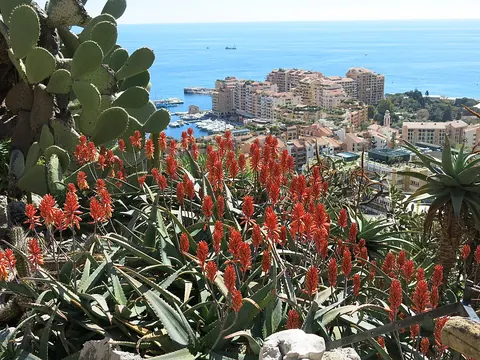
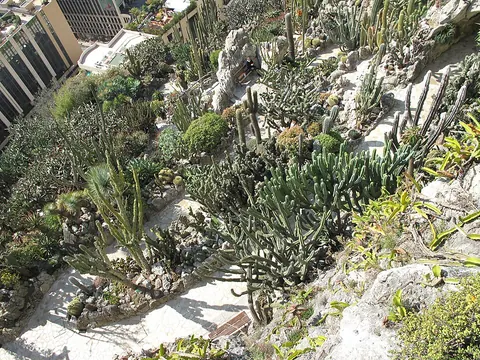


On site, look for: Find a cactus taller than you.
Test yourself
Who officially inaugurated it in 1933?
- Prince Albert I
- Prince Louis II (answer)
- Prince Rainier III
Name of the cave?
- The Dragon
- The Marvellous
- The Observatory (answer)
Which plants grow here?
- Ferns
- Firs
- Succulents and cacti (answer)
Sources
- Wikipédia : Jardin exotique de Monaco
- Wikipedia: Jardin Exotique de Monaco
- Mairie de Monaco : Inauguration du Jardin Exotique de Monaco
- Jardin exotique : préparer ma visite (site officiel)
Information checked on 30 September 2026.