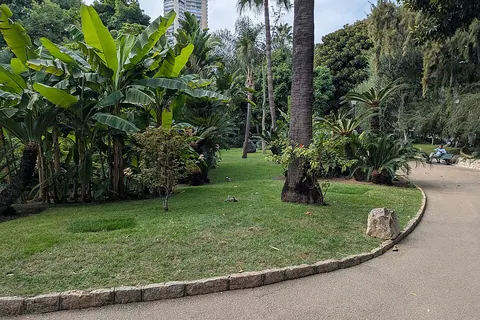

Here you are in the Petite Afrique gardens, on the slope running down from Boulevard des Moulins towards Place du Casino. These gardens are part of the ensemble created at the wish of Prince Charles III. According to Monaco’s tourist office, they were laid out from 1893 by the French landscape architect Édouard André, who also worked in Paris, Liverpool and Luxembourg. His idea was simple: Monte Carlo then welcomed its visitors mainly in winter, so they had to be offered the image of an eternal spring. While the Boulingrins, lower down in front of the Casino, form a formal garden, Petite Afrique was given lush, exotic vegetation. Look for the large Ficus macrophylla, a fig tree from Australia with spectacular roots, and the Ginkgo biloba, a tree whose lineage goes back to very ancient times. Winding paths, dotted with fountains and sculptures, lead to viewpoints over the Casino facade and the sea. Near the tourist office, a statue pays tribute to Charles III. Take your time and stroll in the shade.
History
The Petite Afrique gardens belong to the landscaped ensemble surrounding the Casino de Monte-Carlo. According to Monaco’s tourist office, this ensemble was laid out from 1893 at the initiative of Prince Charles III, who gave his name to the district and made Monte Carlo a sought-after resort.
The prince entrusted the project to Édouard André, one of the most active French landscape architects of his time. Trained in the parks department of Paris, he took part in planting the Buttes-Chaumont park, won the 1866 competition for Sefton Park in Liverpool and turned the old fortifications of Luxembourg into a green belt. In Monte Carlo he started from a simple observation: the Riviera was then above all a winter destination. His gardens therefore had to give the image of an eternal spring.
Art and architecture
Édouard André composed two complementary moods. In front of the Casino, the Boulingrins follow the model of the formal garden, with lawns and orderly beds. On the slope of Petite Afrique, by contrast, he chose lush tropical plants, playing with the terrain.
The paths wind between the beds and open onto views towards Place du Casino, the Belle Époque facade of the Casino and the sea beyond. Fountains and sculptures punctuate the walk. Among the trees highlighted by the tourist office are the Ficus macrophylla, an Australian fig with impressive roots, and the Ginkgo biloba, a species from Asia, as well as rare and ancient specimens.
Anecdotes
The landscape architect of these gardens was also an explorer and botanist. He was the first European to bring back to Europe more than 25 species of Anthurium, one of which bears his name: Anthurium andraeanum.
Near the tourist office, at the top of the garden, a statue pays tribute to Prince Charles III, the founder of Monte Carlo. It is a reminder that these flower beds, like the Casino and the grand hotels nearby, were part of a single project: attracting international visitors with a carefully designed setting.
What to look for
Start at the top, on the Boulevard des Moulins side, then walk slowly down. Look for the large trees with exposed roots, the fountains and the sculptures along the paths. Lower down, stop at the gaps in the greenery that frame the Casino facade.
As you go down, compare Édouard André’s two gardens: at the top, the dense vegetation and shade of Petite Afrique; at the bottom, the open lawns of the Boulingrins. This deliberate contrast between a lush garden and a formal one is the best way to understand his work and the idea of eternal spring he wanted to offer winter visitors.
Practical
The gardens lie between Boulevard des Moulins and Place du Casino, next to the tourist office. Access is free, usually during the day. The paths slope: wear good shoes. For precise opening times, check the Monaco tourist office website.
Nearby
Heading down, you reach the Casino gardens and Place du Casino. Saint-Charles Church and the Hôtel Hermitage are also a few minutes’ walk away. To discover more of Monaco’s gardens, the Exotic Garden and the Princess Grace Rose Garden can be reached by bus or on foot.
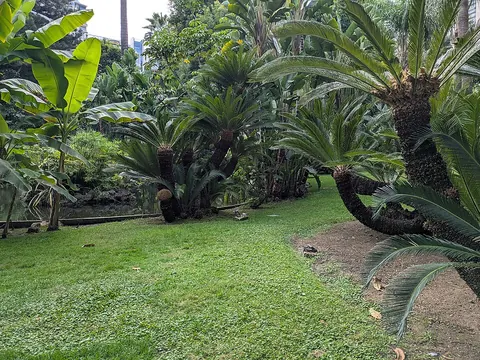

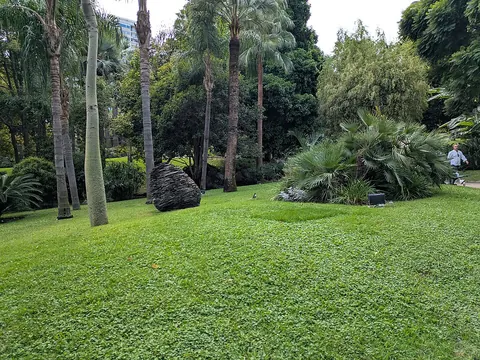

On site, look for: Find a tree whose roots run along the surface of the ground, then a spot where the Casino facade appears through the foliage.
Test yourself
Which landscape architect designed the gardens?
- André Le Nôtre
- Jean Marquet
- Édouard André (answer)
What impression were the gardens meant to give winter visitors?
- A Saharan desert
- An alpine forest
- An eternal spring (answer)
Which country does Ficus macrophylla come from?
- Australia (answer)
- Mexico
- Morocco
Sources
- Visit Monaco : Jardins du Casino de Monte-Carlo
- Wikipédia : Édouard André (paysagiste)
- OpenStreetMap : Jardins de la Petite Afrique
Information checked on 30 September 2026.