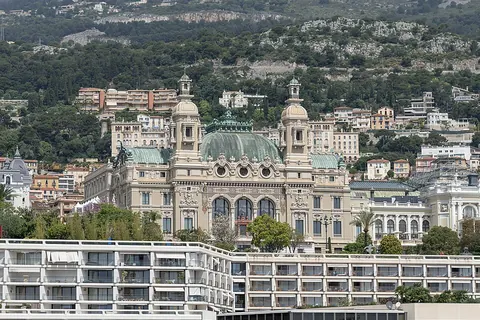

Here is Monte Carlo’s most famous landmark. In the mid nineteenth century Monaco was poor: Menton and Roquebrune, its main sources of income, had broken away. Prince Charles III then bet on gambling and sea bathing. In 1863 the Société des Bains de Mer was founded and entrusted to businessman François Blanc, who had already made a fortune in Bad Homburg. The Spélugues plateau, then covered in olive trees, was renamed Monte Carlo in 1866 in honour of the prince. The railway arrived in 1868, bringing Europe’s aristocracy, and success was such that Monegasques were exempted from direct taxes from 1869. The building, reworked by Charles Garnier, architect of the Paris Opera, glows with gilding, stained glass and paintings. A curious fact: Monegasque citizens are not allowed to gamble in the casino. In the morning you can tour the rooms in peace; at night, the illuminated facade and the luxury cars at the door are a show in themselves.
History
To understand this building, go back to 1848. That year Menton and Roquebrune declared themselves free towns. They made up about 80% of Monaco’s territory and most of its farming income. Left without resources, the principality had to reinvent itself.
The future Prince Charles III bet on leisure for wealthy foreign visitors. A first casino opened in December 1856 in a modest house in La Condamine, the Villa Bellevue. The start was hard: no proper road, few hotels, and one operator after another failing. In 1863 the prince turned to François Blanc, who was successfully running the casino in Bad Homburg, Germany. Blanc received a 50 year concession and took charge of the Société des Bains de Mer, founded that same year. Gaming moved to the Spélugues plateau, renamed Monte Carlo on 1 July 1866, and the arrival of the railway in 1868 made the business take off.
Art and architecture
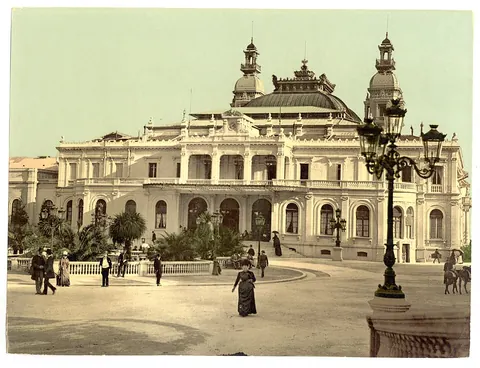
The casino you see is the result of several building campaigns. In 1878 and 1879 it was transformed and enlarged by Charles Garnier, architect of the Paris Opera, and by Jules Dutrou. Garnier added the theatre on the sea side that now bears his name, while Dutrou redesigned the gaming rooms facing the square.
Further extensions followed, including those by Charles Touzet in 1889 and 1890, until 1910, when the building reached its present form. Despite these additions it remains remarkably unified, in the Beaux Arts style of the late Second Empire and the Belle Époque: gilding, stucco, stained glass, paintings and sculpture.
Anecdotes
Even the name of the plateau has a story. Spélugues comes from a Latin word for cave, as the cliff was riddled with them. But in German the word suggested a disreputable place, and François Blanc advised the prince to pick a more flattering name: Monte Carlo, Mount Charles.
The casino has its legends too. In 1873 the English engineer Joseph Jagger spotted a slightly unbalanced roulette wheel and "broke the bank". In the summer of 1913 the ball landed on black 26 times in a row, and many players lost fortunes betting that red was bound to come up: statisticians now call this mistake the gambler’s fallacy. And the random sampling methods used in physics are called "Monte Carlo methods" as a nod to this place.
One last surprise: Monegasque citizens are not allowed to gamble in their own country’s gaming rooms, an old rule confirmed by a law of 1987.
What to look for
From the square, look at the facade framed by its two turrets, with the clock in the centre. Then walk round to the right to the terrace on the sea side: the facade there is different and more ornate, because it belongs to the Salle Garnier. The view stretches over the Mediterranean and, on a clear day, to the Italian coast.
Inside, the marble atrium ringed with columns leads to the salons. Look up at the painted ceilings and the glass roofs.
Practical
The casino stands on Place du Casino, a few minutes’ walk from the harbour. The rooms can usually be visited in the morning, before gaming starts, with an entry ticket. Gaming rooms are for adults only, with photo ID, and smart dress is required, stricter in the evening. Times and prices vary with the season: check them on the official Monte-Carlo Société des Bains de Mer website (montecarlosbm.com) before you come.
Nearby
Right next door you can continue with the Monte Carlo Opera, which occupies the sea side wing, the Hôtel de Paris and the Casino Gardens. During the Monaco Grand Prix the cars pass right in front of the square: this is the famous Casino bend.
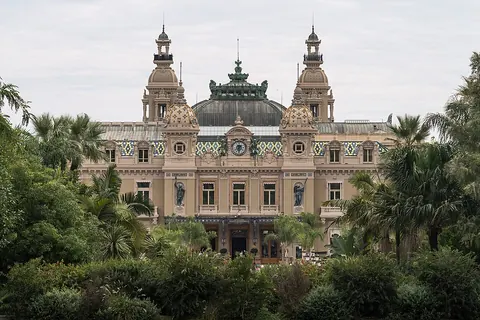


On site, look for: Find the two turrets on the facade and take a photo.
Test yourself
Which prince bet on gambling?
- Albert II
- Charles III (answer)
- Louis II
Which architect reworked it?
- Charles Garnier (answer)
- Gustave Eiffel
- Le Corbusier
Former name of the plateau?
- Les Spélugues (answer)
- Moneghetti
- The Rock
Sources
- Wikipédia : Casino de Monte-Carlo
- Wikipedia: Monte Carlo Casino
- Wikipédia : Plateau des Spélugues
- Monte-Carlo SBM : tarifs et conditions d’admission
Information checked on 30 September 2026.