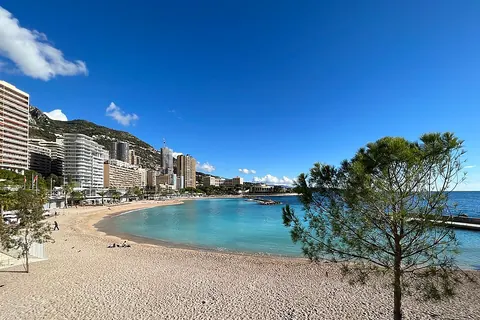

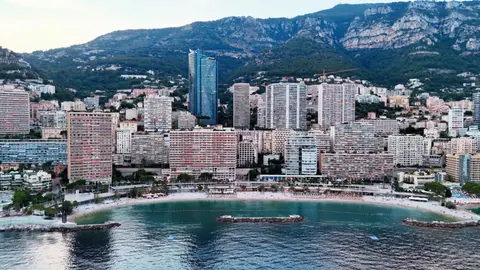
This is Larvotto, Monaco’s big public beach, a short walk from the centre. Unlike many beaches on the Riviera, access is free, and this is where Monegasque families come for a swim. The beach was completely redesigned and reopened in 2021 with a new promenade, green spaces and restaurants. Offshore, a marine reserve protects the Posidonia meadows, underwater plants that oxygenate the Mediterranean and shelter many fish. With a mask and snorkel you may spot salema, rainbow wrasse and sometimes a cuttlefish. Monaco is deeply committed to the sea, following the work of Prince Albert I and of his descendant Albert II, whose foundation supports ocean protection. At dusk the promenade comes alive, the terraces fill up and the sky turns pink above Italy. Please follow the swimming rules and stay within the marked areas.
History
Before the buildings and the promenade, this shore was a marshy, almost empty area: in 1699, only 2 inhabitants were recorded here. Yet there was already a pebble beach, and the arrival of the railway in Monaco in 1868 brought the first bathers. The area was first called the "Mouettes" (the Gulls), then the "Bas-Moulins". The name Larvotto is said to come from an old word for a curve of the coast, found in land registry documents from the 19th century.
Between the two world wars, the Société des Bains de Mer laid out a coastal road lined with palm trees, Larvotto beach, restaurants and nightspots. In 1966, Prince Rainier III officially created the Larvotto district, and apartment buildings gradually lined Avenue Princesse Grace. In the early 2020s, the architect Renzo Piano was asked to rethink the whole eastern part of the principality, including the beach complex, which reopened in 2021.
Art and architecture
Much of what you see here is man-made. Nearly a third of the district was reclaimed from the sea through landfill, which now holds the Grimaldi Forum, the Japanese Garden and a large hotel complex. The beach itself is landscaped and protected by rock works that calm the waves and create sheltered bathing areas.
The renovation aimed to bring order to this seafront: a continuous promenade, planted areas and neatly aligned establishments, so that the beach remains above all a public place open to everyone.
Anecdotes
Underwater, the Larvotto reserve protects Posidonia seagrass meadows, dusky groupers and noble pen shells, large shellfish that have become very rare in the Mediterranean. At the end of 2016, to prepare for the construction of the new Portier district, 47 noble pen shells were carefully moved to the Larvotto seabed, along with slabs of Posidonia and rocks. In the reserve, fishing, anchoring and boat traffic are prohibited.
Since the Portier beach closed, Larvotto has been the last public beach in Monaco. The poet Robert William Service, who lived in Monaco, came here to swim from May to October. Today the Monegasque freediver Pierre Frolla runs his diving school here, the École Bleue.
What to look for
Walk the whole length of the beach and look east to the new Portier district, completed in 2024, which extends the coast. With a mask, in the permitted areas, look at the seagrass and the fish near the rocks. At the end of the day, the low light over the sea and the mountains towards Italy is worth the moment.
Practical
The beach runs along Avenue Princesse Grace, about 15 minutes on foot from Casino Square via the Grimaldi Forum. Bus line 5 serves the district. Access to the public beach is free. Please respect the marked swimming areas, the lifeguards’ instructions in season and the rules of the marine reserve. For lifeguard hours and any restrictions, check with the Monaco town hall or the tourist office.
Nearby
Nearby you can visit the Japanese Garden, the Grimaldi Forum or the Villa Sauber. Continuing east, the promenade leads to the Portier district. To learn more about marine protection in Monaco, the Oceanographic Museum on the Rock and the Prince Albert II Foundation present the work carried out for the Mediterranean.

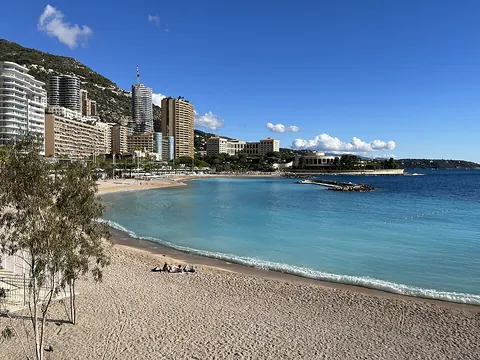

On site, look for: Look east and spot the Italian coast.
Test yourself
Beach access is…
- Free (answer)
- Paid
- Residents only
What does the reserve protect?
- Giant corals
- Posidonia (answer)
- Seals
Reopened after works in…
- 1995
- 2010
- 2021 (answer)
Sources
Information checked on 30 September 2026.