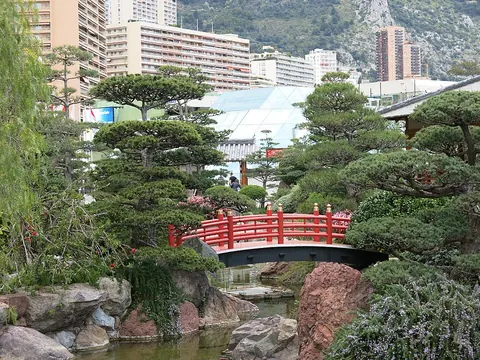
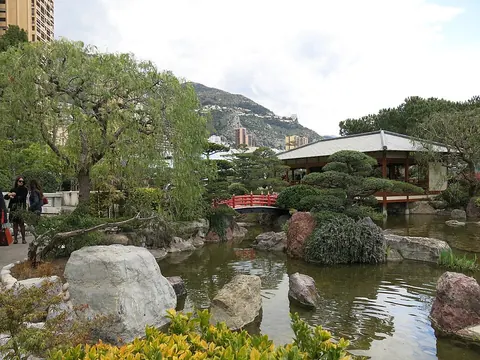
Between the Grimaldi Forum and the sea lies a small world of serenity: the Japanese garden. Opened in 1994, it was designed by landscape architect Yasuo Beppu, winner of international awards, following the principles of Zen and Shinto gardens. Every element has meaning: water, which tumbles down a cascade and then calms in a pond where koi carp glide; stones, which stand for mountains; bridges, which invite you to pass from one world to another. Patiently pruned pines, stone lanterns and raked sand form pictures that change with the seasons. A traditional tea house stands by the water. The garden was blessed by a Shinto priest, and visitors are asked to keep it peaceful. Slow down, listen to the water, watch the clouds reflected in the pond: it is the perfect pause in a busy day. Children love spotting the big colourful carp.
History
This garden was commissioned by Prince Rainier III. It was created in 1994 by the Japanese landscape architect Yasuo Beppu, who had won the grand prize at the Osaka Flower Exhibition in 1990. The prince wished to give residents and visitors a genuine Japanese garden, faithful to tradition, in the heart of the Larvotto district.
The land itself has a recent history. Nearly a third of Larvotto was reclaimed from the sea through landfill, and it is on this new ground that the Grimaldi Forum and this garden were built. The garden was in fact laid out on a concrete slab, which makes the presence of trees, rocks and ponds all the more remarkable.
Art and architecture
On about 0.7 hectares, Yasuo Beppu composed a miniature representation of Shinto philosophy. The garden brings together several typical landscapes: a stylised mountain, a hill, a waterfall, a beach, a brook, and a Zen garden set aside for meditation. It is described as an educational presentation of characteristic scenes, designed according to the strictest principles of Zen thought.
Nothing here is left to chance. Stones are placed to suggest relief, water leads the eye from one point to another, and plants are pruned to keep compact, harmonious shapes. The paths make you slow down and reveal the garden in a series of scenes, like turning the pages of a book.
Anecdotes
The garden has even been honoured by philately: a Monegasque stamp designed by Jean-Paul Véret-Lemarinier was devoted to it on 24 March 2011, in the series "Flowers and Gardens".
It also hosts cultural events linked to Japan from time to time. In November 2024, for instance, it presented an exhibition of Bizen ceramics, a Japanese pottery tradition, with works by Jun Isezaki, recognised in Japan as a Living National Treasure, alongside young contemporary artists.
What to look for
Follow the water from the waterfall down to the pond, where the carp glide. Pause on the bridges to look at the reflections, then look for the Zen garden, plainer and made for contemplation. Notice too the contrast between this quiet little world and the buildings of Avenue Princesse Grace all around: it is part of the charm of the place.
Practical
The garden is at 5 Avenue Princesse Grace, in the Larvotto district, right next to the Grimaldi Forum. From Casino Square, allow about ten minutes on foot heading down towards the sea. It is usually open every day from 9 am until sunset, and entry is free. The place invites calm: walk gently and stay on the paths.
Nearby
On your way out, you can visit the neighbouring Grimaldi Forum, stroll along the Larvotto beach promenade, or continue a little further along the avenue to the Villa Sauber. For other gardens, Monaco also has the Exotic Garden and the Princess Antoinette Park. Up-to-date information on public parks is available from the Monaco town hall and the tourist office, at visitmonaco.com.


On site, look for: Count the orange koi you see in one minute.
Test yourself
Who designed it?
- Charles Garnier
- Tadao Ando
- Yasuo Beppu (answer)
What do the stones stand for?
- Mountains (answer)
- Stars
- The princes
Opened in…
- 1910
- 1994 (answer)
- 2021
Sources
- Wikipédia : Jardin japonais de Monaco
- Wikipedia: Japanese Garden, Monaco
- Wikipédia : Le Larvotto
- JGarden : Jardin japonais de Monaco (fiche du service de l’Aménagement urbain, archive 2013)
- OpenStreetMap : Jardin Japonais
Information checked on 30 September 2026.