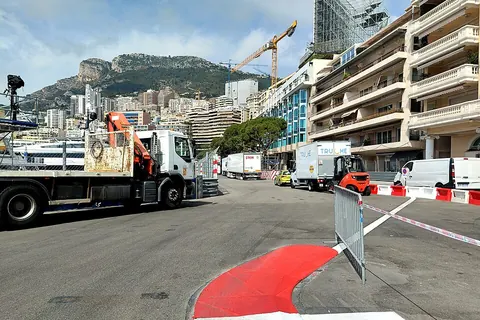

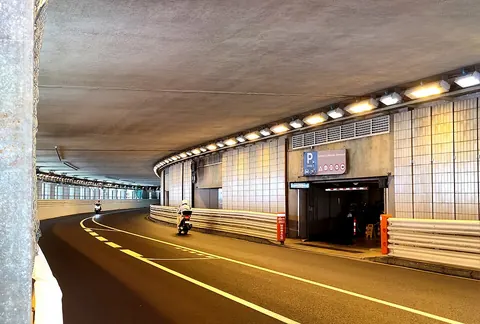
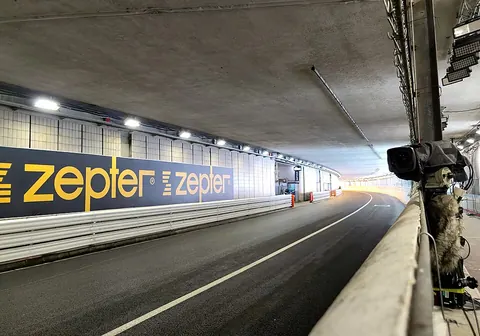
You are at the exit of the only tunnel in the Formula One world championship. It curves beneath the Fairmont hotel and is the fastest part of the circuit: cars exceed two hundred and fifty kilometres per hour here. For drivers the challenge is twofold. In the tunnel, aerodynamic downforce changes and the cars feel lighter; at the exit they burst from shadow into full daylight, and their eyes must adjust in a split second. Right in front of you they brake with all their might for the harbour chicane, one of the best overtaking spots. In 1955 the Italian driver Alberto Ascari missed this chicane and plunged into the harbour in his Lancia; he swam out with minor injuries. The story is part of Grand Prix legend. For your safety, do not walk into the tunnel: it is a busy road. Enjoy the view of the yachts instead.
History
You are at the tunnel exit, facing Port Hercule. The cars come down from Portier, plunge under the buildings and burst out here into full daylight before braking for the harbour chicane. The tunnel was lengthened in 1973, when the Loews hotel, now the Fairmont, was built over the road.
The chicane has moved often. In 1955 it was set further from the tunnel exit; in 1972 it was brought closer to Tabac. In 1986 a wider road allowed the old fast change of direction, judged too dangerous, to be replaced by a double 90 degree turn: the "Nouvelle Chicane".
Art and architecture
The tunnel exit is the fastest part of the circuit: according to Wikipedia, cars approach 300 km/h here. For drivers the challenge is twofold. The sudden change from shade to light affects vision, and a car can lose 20 to 30% of its downforce in the tunnel.
Right after, the left right left Nouvelle Chicane demands the heaviest braking of the lap. It is generally the only place on the circuit where an overtake can be attempted.
Anecdotes
In 1955 the chicane entered legend. Alberto Ascari, who had just taken the lead after Stirling Moss retired, missed the chicane: his Lancia went through the barriers into the harbour. Ascari swam to safety and spent the night in hospital while a crane lifted the car out. Maurice Trintignant, in a Ferrari, inherited the win, his first in Formula One.
More recently, Wikipedia lists big accidents here: Karl Wendlinger in 1994, Jenson Button in 2003 and Sergio Pérez in 2011. After 2011 the drivers asked for changes between the tunnel and the chicane, without result.
The tunnel is also a problem in the rain: it stays dry while the rest of the track is wet. Before the very wet 1984 race, at Niki Lauda’s request, Bernie Ecclestone had firefighters wet the tunnel to even out the grip.
What to look for
From the pavement, look at the tunnel mouth and then the curve dropping to the quay: this is the path the drivers take at full speed. In front of you, the boats of Port Hercule mark the place where Ascari’s Lancia ended its race.
Look for the outline of the chicane on the road too: outside the Grand Prix the kerbs are removed and you need a little imagination to find it.
Practical
The circuit is a public road, open to traffic all year outside the Grand Prix. Never walk into the tunnel: it is a busy road with no pedestrian path. Keep to the quayside pavements and cross at the marked crossings.
During the build and on race weekend, access changes. Check the Automobile Club de Monaco website (acm.mc).
Nearby
Walk along the quay to Tabac and the Rainier III pool, then on to La Rascasse. In the other direction, climb via Portier to the Fairmont hairpin.
For the 1955 story, read the Wikipedia article "1955 Monaco Grand Prix"; for the chicane’s history, the article "Circuit de Monaco".


On site, look for: Spot where Ascari went into the harbour.
Test yourself
Speed in the tunnel?
- 150 km/h
- 80 km/h
- Over 250 km/h (answer)
Who ended up in the harbour in 1955?
- Alberto Ascari (answer)
- Ayrton Senna
- Niki Lauda
Can you walk through the tunnel?
- No, it is not advised (answer)
- Only at night
- Yes, it is designed for it
Sources
- Wikipédia : Circuit de Monaco
- Wikipedia: Circuit de Monaco
- Wikipedia : 1955 Monaco Grand Prix
- Automobile Club de Monaco : calendrier
Information checked on 30 September 2026.