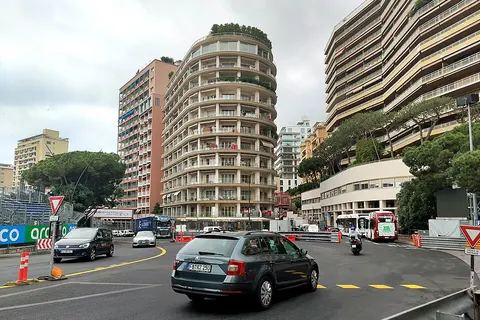

You are at the first corner of the Monaco circuit, the famous Sainte-Dévote, named after the little church right beside it. The Monaco Grand Prix was born in 1929 on the initiative of Antony Noghès, who wanted a race through the streets of the town; the first edition was won by a driver racing under the name Williams, in a Bugatti. The layout, about 3.3 kilometres long, has changed little in its broad lines since then. Here the cars arrive from the pit straight and must brake hard for this near right angle right hander. At the start it is the most dangerous spot: twenty cars try to squeeze through a tiny space at once, and collisions are common. The rest of the year it is an ordinary junction with buses and scooters. Look at the painted kerbs and imagine the roar of engines echoing between the buildings. Next, the race climbs Beau Rivage towards the Casino.
History
Sainte-Dévote is the first corner of the Monaco circuit. It takes its name from the little Sainte-Dévote Chapel, tucked just behind the barriers at the foot of the Gaumates valley. The idea of a race through the streets of the principality came from Antony Noghès, president of the Automobile Club de Monaco. The first edition was run in 1929 and won by William Grover-Williams in a Bugatti.
In the early years the start and finish were on Boulevard Albert Ier, the straight that leads to this corner. In 1955 they moved to the opposite straight, on the harbour side, before returning to Boulevard Albert Ier in 1963. The corner itself has been reshaped several times: in 1952 alterations shortened the lap to 3.145 kilometres, and in 1976 kerbs and barriers were repositioned to slow the cars.
Art and architecture
Sainte-Dévote is a nearly 90 degree right hander, usually taken in first or second gear. Straight after it, the road climbs Avenue d’Ostende towards the Casino, with a gradient of up to about 12%.
Before the 2003 race a small roundabout sat on the apex. It was removed to widen the track, which is now marked only by the kerb. Since then, for safety reasons, the pit exit has been extended: cars leaving the pit lane must stay behind a yellow line that cuts across the corner.
Anecdotes
This is the classic place for first lap collisions. At the start the whole field arrives here together, and one narrow corner has to swallow every car. According to Wikipedia, these accidents have become less common since the roundabout was removed and the entry made wider.
The pit straight leading to Sainte-Dévote holds the circuit’s only DRS zone, 510 metres long, between the Antony Noghès corner and Sainte-Dévote. Monaco is one of the few tracks in the championship with just one.
What to look for
Outside the Grand Prix, Sainte-Dévote is an ordinary junction used by buses, cars and scooters. Look at the chapel: it gave the corner its name, and it is dedicated to the patron saint of Monaco. Then look up Avenue d’Ostende and you will see the climb the cars attack at full throttle.
In spring you may see the installations going up: building the circuit takes about 6 weeks, and taking it down another 3.
Practical
The circuit is a public road, open to traffic all year outside the Grand Prix. Keep to the pavements, cross only at pedestrian crossings and never stop in the road for a photo: this junction is very busy.
During the build weeks and on race weekend, access around the circuit may change or require a ticket. Check the Automobile Club de Monaco website (acm.mc) for dates and tickets.
Nearby
A few steps away, the Sainte-Dévote Chapel is worth a short visit. Following the track, climb to Casino Square, then walk down to Mirabeau and the Fairmont hairpin.
For the full story of the race, read the Wikipedia articles "Circuit de Monaco" and "Monaco Grand Prix", and the official site acm.mc.
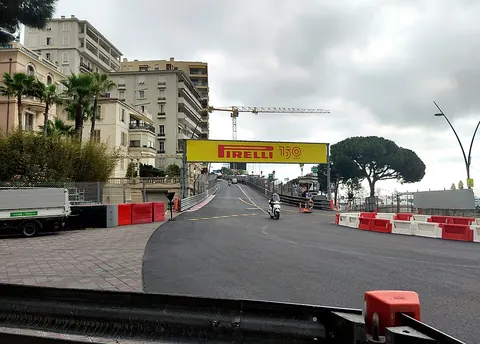

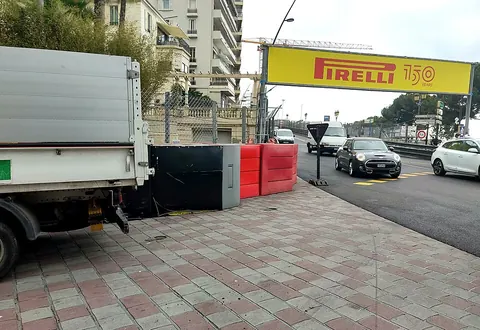

On site, look for: Find the red and white painted kerbs.
Test yourself
Year of the first Grand Prix?
- 1929 (answer)
- 1950
- 1970
Who created it?
- Antony Noghès (answer)
- Enzo Ferrari
- Louis II
Circuit length?
- 1 km
- 7 km
- About 3.3 km (answer)
Sources
Information checked on 30 September 2026.